
Haskell Projected Versus Actual Release
A projected date is an agency calculation based on the sentence, its start date, court-awarded jail credit, and credits allowed by law. Kansas KASPER calls the public milestone Earliest Possible Release Date (1). Its footnote warns that a Prisoner Review Board decision or good time and program credit can affect the date. The exact label matters. “Earliest possible” does not mean final, approved, or guaranteed.
An actual release is the completed custody event. Processing, another agency's hold, an amended order, a transfer, or a calculation correction can separate it from the projected date. For the Haskell County Jail, the sheriff's release ledger is the source for the physical release timestamp. The Haskell District Court record identifies the judicial authority. A court order entered at one time is not proof that jail processing ended at that same time.
Find a Haskell Release Date
Identify the custodian before searching. The Haskell County Jail and a KDOC prison use different records. Kansas VINE can report adult county-jail custody changes, but it does not include KDOC prisoners. KASPER includes people currently incarcerated, under post-incarceration supervision, and discharged from a KDOC sentence.
- Ask which agency currently holds the person and whether the case is pretrial, a local jail sentence, or a KDOC sentence.
- For KDOC custody, open the KASPER search, accept its disclaimer, and match the person by name and available identifiers.
- Read Current Status, Current Location, Admission Date, movement history, and Earliest Possible Release Date when displayed.
- For Haskell jail custody, contact the sheriff and review the criminal docket for bond, sentence, jail credit, commitment, and hold information.
- Recheck near the anticipated date because KASPER updates on working days and custody facts can change.
The broader Haskell County release search explains the release-ledger and court routes when a person has already left a live custody source. A missing KASPER result does not prove local release, and a KASPER date should never be copied onto a county booking.
Haskell Pretrial Release Has No Date
A pretrial detainee has not received a final prison-term calculation. Release may turn on a bond order, completion of bond processing, dismissal, a change in conditions, transfer, or later disposition. The court docket can show the order, while the jail record shows when custody actually changed. Another county, state, federal, or immigration hold can prevent release to the community even after the Haskell matter permits it.
Call the Haskell County Sheriff's Office at 300 S. Inman, Sublette, KS 67877, 620-675-2289 for the jail status and release or transfer record. No official Haskell online roster, projected-date tool, or local good-time policy was verified. Do not estimate a local date from a sentence alone.
- Bond
- A court-set means of securing release while the case proceeds.
- Jail credit
- Time the court awards against a sentence for eligible prior custody.
- Detainer
- A request from another agency to hold or receive the person.
- Discharge
- Completion of the sentence obligation, including supervision, as recorded by KDOC.
Kansas Good Time for Haskell Cases
K.S.A. 21-6821 limits good-time reduction to 15 percent of the prison portion for crimes committed on or after July 1, 1993, while providing 20 percent bands for specified nondrug severity levels 7 through 10 from January 1, 2008 and identified drug severity and date groups. The common “serve 85 percent” phrase describes the 15-percent band only. It is not a universal Kansas formula.
The law also authorizes program credit for eligible groups after successful completion of designated education, technical, vocational, substance-use, or risk-reduction programs. The current statutory maximum is 120 days. It must not be added automatically. Eligibility, completion, forfeiture, restoration, and KDOC calculation determine the effect. The sex-offender treatment program is excluded from that program-credit provision.
The official Kansas good-time statute captured for this page shows the controlling credit framework.
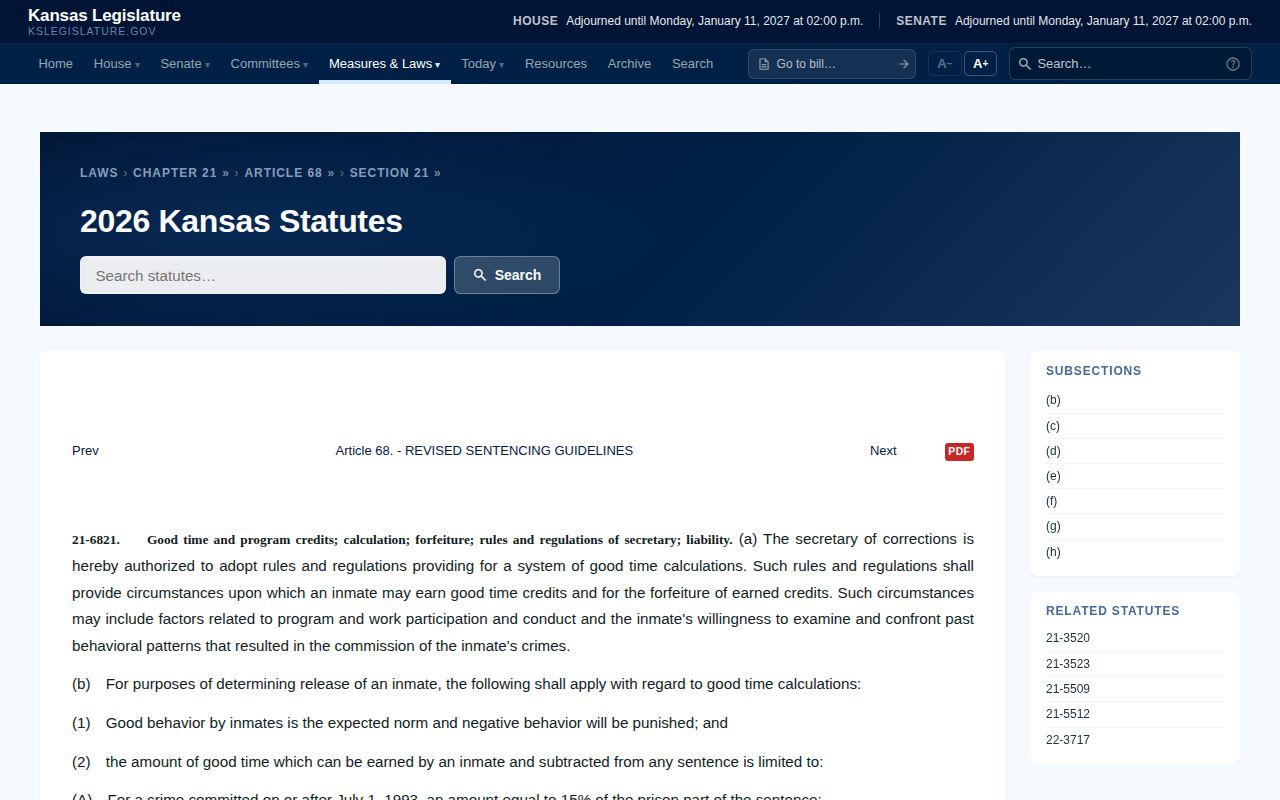
The statutory text is more reliable than shorthand because the applicable percentage depends on the offense severity, date, and sentence structure.
How Kansas Computes Haskell Dates
K.S.A. 21-6806 states that imprisonment is time actually served subject to authorized good-time reduction. Kansas administrative calculation starts with the sentence-begins date and adds the controlling guideline sentence duration. Court-awarded jail credit can affect that start. Consecutive cases and allocation of credit can create a result that simple subtraction from one docket sentence will miss.
Crimes committed before July 1, 1993 can fall under the older indeterminate framework and K.S.A. 22-3725. Parole eligibility may depend on the minimum term less applicable good time. Modern determinate sentences more often reach a calculated prison release followed by postrelease supervision, subject to offense-specific and off-grid exceptions.
K.S.A. 22-3717 is date and offense specific. Eligibility does not equal release, and leaving prison does not always mean sentence discharge. Postrelease or parole can continue after physical custody ends.
Why Haskell Release Dates Change
A date can move because the underlying sentence calculation or the person's legal status changes. KASPER's working-day update schedule can also make a correct agency event appear later on the public screen.
| Factor | Possible effect |
|---|---|
| Good-time award, loss, or restoration | Changes credit used in the KDOC calculation. |
| Program credit | May reduce an eligible term after approved completion, within the statutory cap. |
| Corrected jail credit | Changes the sentence-begins calculation. |
| Amended sentence or appeal | Changes the controlling legal order. |
| Consecutive cases | Combines terms and can extend the controlling date. |
| Board pass or continue | Delays release in a parole-eligible case. |
| Detainer or other hold | Can route the person to another custodian instead of the community. |
| Data correction or display lag | Changes when or how the public date appears. |
No fixed Haskell weekend-release practice was found. Ask the jail about processing for the specific person rather than assuming a court date, weekend adjustment, or release hour.
Confirm Haskell Projected Release
For KDOC, compare Earliest Possible Release Date with Current Status and Current Location, then contact the responsible facility or KDOC when the event is close. For local custody, obtain the Haskell booking and release or transfer ledger entry and the district court order. Those records distinguish a completed release from movement to another jail or prison.
Kansas VINE can send a county-jail custody-change notice, but its special boundary remains important: it excludes KDOC state prisons. Registration details are covered on the Haskell County VINELink inmate search. Use KASPER for state custody and the sheriff for the county jail.
Note: State the narrow result the record supports, such as projected milestone, completed jail release, transfer, or full sentence discharge.
Parole Dates in Haskell Records
Parole eligibility, a board hearing, physical release, and sentence discharge are separate milestones. For an older indeterminate sentence, the Kansas Prisoner Review Board may decide whether release is suitable after eligibility arrives. Its basic outcomes include parole, continue, and pass. A continue delays a decision for more information, votes, or review. A pass denies parole for the stated period.
The board's monthly public-comment and hearing material is forward looking. It is not a person-by-person decisions database. A Haskell County conviction can appear even though there is no state prison in the county, but conviction county does not establish where a person lives or where release will occur. Check KASPER after its working-day update and contact the board or KDOC for a named outcome.
Modern determinate sentences usually lead to a calculated prison release and postrelease supervision rather than traditional discretionary parole. An Earliest Possible Release Date may mark the prison portion, not the end of every KDOC duty. Current Status and supervision information reveal whether authority continues after the person leaves the facility.
County and State Date Differences
The Haskell County Jail handles local booking and holding. KDOC calculates state sentences. A person may move from the jail to KDOC after sentencing, and the two systems can display different dates because they describe different events. The county transfer time records departure from local custody. KASPER then reflects admission, location, sentence calculation, supervision, and eventual discharge in the state system.
| Date or event | Originating record | Meaning |
|---|---|---|
| Bond order date | Haskell court | The judicial authority for release, not necessarily the exit time. |
| Release timestamp | Sheriff ledger | When local custody ended under the recorded route. |
| Transfer timestamp | Sheriff ledger | When another custodian received or was due to receive the person. |
| Earliest Possible Release Date | KASPER | A conditional KDOC milestone affected by law and credits. |
| Sentence discharge | KDOC | The end of the KDOC sentence obligation and supervision. |
Request the transfer destination when a local record merely says “released.” That one field prevents a move to prison or another jail from being mistaken for a return to the community.
Correct a Haskell Release Date
When KASPER appears wrong, preserve the profile and access date, then compare it with the sentencing order, jail-credit award, and any amended or appellate order. Send a concise correction request to KDOC at kdoc_pub@ks.gov. Identify the record and the disputed field, attach or cite the official source, and ask the agency to explain the calculation rather than proposing an unsupported date.
A county entry must go to the sheriff, while an order or docket entry must go to the Haskell District Court custodian. Each office can correct only the record it created. Keeping those roles separate reduces delay and preserves a clear audit trail.
Do not recalculate a date from a news report or a bare sentence length. The controlling sentence may include more than one case, and the public account may omit jail credit, an amended order, a detainer, or the offense date that selects the governing law. Ask for the agency's field and explanation. When no projected field appears, that absence may reflect the sentence type or record status rather than a missing release.
Preserve the answer with its access date. A later KASPER update may legitimately replace it after credit, discipline, court action, or a board decision. The final verified statement should name both the date and its type, such as Earliest Possible Release Date, jail release time, parole eligibility, or sentence discharge.
Public Record Search
Sponsored Results