
Haskell Parole and Probation
A Haskell County jail release does not, by itself, identify the next legal stage. Parole and postrelease supervision generally follow imprisonment under the Kansas Department of Corrections. Probation or community corrections may follow a Haskell District Court sentence without a state-prison term. Both allow a person to live outside a jail or prison while remaining subject to rules, reporting, and agency oversight. The correct record depends on the sentence path.
Parole is supervised release used in eligible sentence structures and is tied to KDOC and the Kansas Prisoner Review Board. Postrelease supervision follows many modern determinate prison sentences. Probation is a court-ordered alternative to confinement or a condition imposed after a local jail term. Community corrections is a more structured local supervision program. The court file supplies the sentence terms, while the supervising office confirms current agency status when disclosure is allowed.
| Supervision type | Usual source | Haskell County route |
|---|---|---|
| Parole | KDOC after an eligible prison sentence | KASPER and Garden City Parole Office |
| Postrelease | KDOC after a determinate prison term | KASPER and Garden City Parole Office |
| Probation | Haskell District Court sentence | Court docket and supervising court service |
| Community corrections | Local court with regional supervision | Cimarron Basin Community Corrections |
| Discharge | Completed sentence obligation | KASPER for KDOC or the court record for probation |
- Parole
- Release from prison under KDOC oversight before the full sentence obligation ends.
- Probation
- A court sentence served in the community under stated conditions.
- Postrelease
- A supervision term that begins after the prison part of a determinate sentence.
- Discharge
- The end of the whole sentence obligation and its supervision.
Verify Haskell Post-Release Supervision
Start with the custody history, not a guess based on where the person lives. A Haskell County conviction can lead to KDOC confinement elsewhere, and a person convicted in Haskell County may not return here. For a state case, the KASPER search includes people in prison, under post-incarceration supervision, and discharged from sentence. For a local probation case, the Haskell court record and Cimarron Basin office are more useful because KASPER warns that community-corrections probation events after April 21, 2021 cannot display.
- Read the Haskell criminal case for the sentence, commitment, probation, revocation, and discharge entries. Use the Kansas court portal, then ask the clerk for a public document that is not online.
- If the sentence includes KDOC custody, accept the KASPER disclaimer and search by KDOC number when known. Otherwise, use the exact name and compare identifiers and the Haskell conviction case.
- Read Current Status and the location or supervision location together. A person outside prison may still have an active parole or postrelease term.
- Contact the Garden City Parole Office for current Haskell-area parole facts the agency may disclose. Do not substitute a probation office for this step.
- For probation or community corrections, contact Cimarron Basin and compare its information with the latest Haskell court order.
- Confirm the end of supervision through a sentence-discharge entry, maximum-sentence status, court discharge order, or the responsible office.
The complete release path may require several records. The Haskell County released-inmate search explains how a sheriff release entry, court disposition, and KDOC record fit together. Kansas VINE is useful for adult county-jail custody changes, but the Attorney General says it excludes KDOC state-prison offenders. It cannot replace KASPER for parole or postrelease verification.
Two Haskell Supervision Offices
Haskell County uses a clear two-office split. The KDOC parole directory assigns the county to the Garden City Parole Office in the South Region. That office handles the state side of supervision after KDOC imprisonment. Probation and community corrections route to Cimarron Basin in Liberal. The distinction helps prevent a common error: asking a local probation office to verify a state-prison parole term, or asking KDOC to supply a local probation event its public repository cannot display.
Garden City Parole Office
KDOC South Region
816 N. Campus Drive, Suite 500
Garden City, KS 67846
620-272-3879
Cimarron Basin Community Corrections
415 N. Washington, Suite 120
Liberal, KS 67901
620-626-3284
Monday-Friday, 8:00 a.m.-5:00 p.m.
The official Cimarron Basin page expressly lists Haskell with Grant, Morton, Seward, Stanton, and Stevens Counties. This regional design is not a sign that the case belongs to Seward County. Haskell District Court remains the source for a Haskell sentence, while the Liberal office supplies the regional supervision link.
The official KDOC office image helps locate the state parole contact. The source is the parole office directory.
That directory supports the Garden City assignment, while the separate regional page supports the Cimarron Basin probation route.
Haskell Parole Absconder Checks
KDOC maintains a separate parole-absconder search that can filter by last supervision location. An absconder is a supervised person whom the agency reports as no longer in contact as required. The label does not prove a new offense. It is not a court warrant record, and it does not establish the person's present location. Use it only as a lead for agency verification.
Search by reliable identifiers and review the last supervision location. Same-name records and old locations can mislead. The KASPER disclaimer gives 785-414-7755 for parole-absconder information. A court docket may separately show a warrant or revocation filing, but that court entry must be read on its own terms. Do not approach a person based on a search result. Contact KDOC or law enforcement if a current safety or warrant issue needs official handling.
The KDOC filter page shows how parole absconders are separated from the standard offender search.
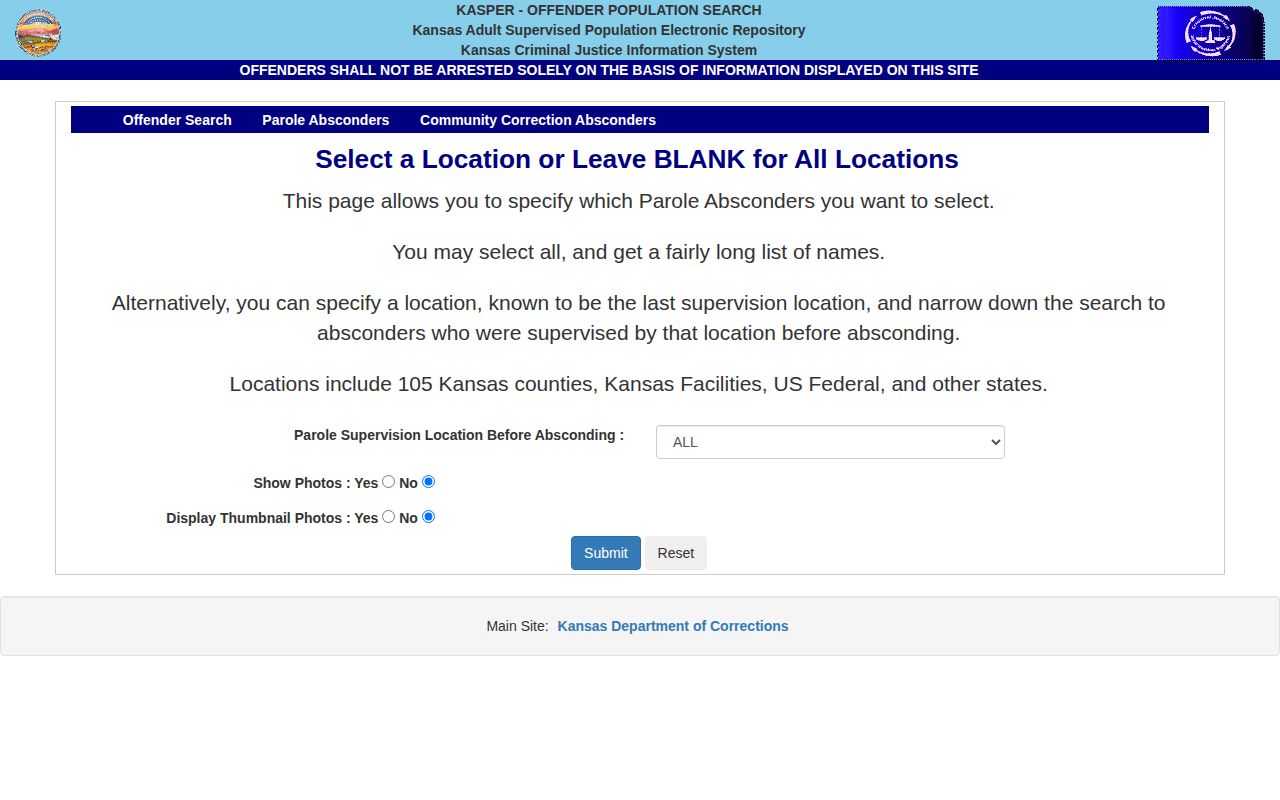
The dedicated filter is a status lead, not proof of a warrant or completed Haskell County release.
Haskell Parole Hearing Records
The Kansas Prisoner Review Board publishes monthly public-comment and hearing material. Public-comment sessions generally occur one month before the parole hearing. A listed case shows eligibility for review, not a promised release. The material may include a commitment name, KDOC number, county of offense, case, offense, and facility. Haskell County has appeared in current monthly material, but conviction county does not establish residence or the place of release.
The board process distinguishes parole, continue, and pass. A continue postpones the matter for more deliberation, facts, votes, or evaluation. A pass denies parole for a stated period under the applicable rules. No public person-by-person decisions search was found. For an individual result, check KASPER after its working-day update, contact the board, or make a focused public-record request. Eligibility under K.S.A. 22-3717 is highly dependent on offense and date.
Haskell Supervision Discharge Records
KDOC's sentence-discharge or maximum-sentence terminology means the whole KDOC obligation is complete. By contrast, parole, conditional release, and postrelease all mean the person remains under state authority after leaving prison. Read Current Status with the maximum or discharge date and movement history. KASPER updates each working day, so a very recent change may lag.
A probation discharge belongs in the Haskell case or with the supervising court program. It should not be inferred from a blank KASPER result. Likewise, the end of a jail stay does not end a pending court case. Obtain the court's discharge order or the supervising agency's confirmation. A narrow conclusion is safest: released from confinement, under supervision, or discharged from the sentence. Each phrase describes a different point.
Public records may be sealed, protected, or expunged under Kansas law. Expungement is a court process that restricts access to qualifying records; it is not the same as supervision discharge. Under K.S.A. 21-6614, some waiting periods run from satisfaction of the sentence or discharge from probation, community corrections, parole, postrelease, conditional release, or a suspended sentence. Check the current statute and Haskell District Court for the specific case.
A defensible status check keeps the dates in order. Note the jail or prison exit first, the start of supervision next, and the final discharge last. Compare the KDOC number, court case, conviction county, and supervision location before joining records. County of conviction is not the same as current home county, and it does not predict where a person will report after release. When a KASPER entry conflicts with a source document, KDOC accepts written corrections or comments at kdoc_pub@ks.gov. Court-record questions go to the court that created the entry.
Conditions and violations also require restraint. A supervision condition is a rule imposed by the court or supervising authority, such as reporting as directed or complying with a treatment plan. A violation allegation can lead to agency review or a court proceeding, but it is not the same as a final revocation. Revocation means the authority has formally withdrawn the community placement under the applicable process. The public court register may show a filing before it shows the result, so read later entries and orders before drawing a conclusion.
KDOC parole information and a Haskell probation docket can describe different parts of one person's history. Keep both when the sentence changed after a revocation, new case, or commitment. The narrowest supported statement is best: the public record showed active postrelease supervision on the access date, the court docket showed probation, or the agency record showed discharge. That wording preserves the difference between a live status and a past event.
FCRA use restriction: These records are for release and supervision verification, personal knowledge, court processes, and records requests. They may not be used for any purpose regulated by the Fair Credit Reporting Act.
Public Record Search
Sponsored Results